Every project carries a clock. The crane that arrives a day late costs more than the day itself. It costs the programme, the crew, and the confidence of the client watching from the site office. In the UAE, where construction moves at a pace calibrated to Vision ambitions and Expo legacies, getting the equipment decision right from day one is not a procurement detail. It is a competitive edge.
The core question for any contractor working in Dubai, Abu Dhabi, or across the Northern Emirates is straightforward: do you rent equipment for the length of the job, or do you pull in machines project by project? Long-term equipment rental UAE and short-term hire serve different financial and operational logics, and mixing them without a clear framework wastes money. CDHorizon, one of the leading construction equipment rental companies in the UAE, works with contractors every day on exactly this decision.
This guide lays out the real cost drivers, the scenarios where each model wins, and the data behind the UAE’s surging rental market, so you can make the call with clarity rather than convention.
The global construction equipment rental market stood at USD 141.42 billion in 2026 and is projected to reach USD 179.21 billion by 2031, at a compound annual growth rate of 4.85%, according to Mordor Intelligence.
Grand View Research places the figure higher, valuing the global market at USD 213.7 billion in 2025 and forecasting growth to USD 339.0 billion by 2033, at a CAGR of 6.1%, driven substantially by infrastructure investment in the Middle East and Asia-Pacific.
The UAE sits at the centre of that Middle East growth story. According to Mordor Intelligence’s UAE construction market report, the UAE construction sector was valued at USD 44.54 billion in 2026 and is expected to reach USD 55.81 billion by 2031, growing at 5.64% CAGR. Mega-projects across Dubai South, Yas Island, and the Northern Emirates pipeline are sustaining the demand for both short-duration hire and multi-year fleet arrangements.
| Metric | Figure | Source |
| Global equipment rental market (2026) | USD 141.42 billion | Mordor Intelligence |
| Global equipment rental market (2031 forecast) | USD 179.21 billion | Mordor Intelligence |
| Global CAGR 2026-2031 | 4.85% | Mordor Intelligence |
| Grand View Research (2025 base) | USD 213.7 billion | Grand View Research |
| Grand View Research (2033 forecast) | USD 339.0 billion | Grand View Research |
| UAE construction market (2026) | USD 44.54 billion | Mordor Intelligence |
| UAE construction market (2031 forecast) | USD 55.81 billion | Mordor Intelligence |
| UAE construction CAGR 2026-2031 | 5.64% | Mordor Intelligence |
Short-term equipment hire in the UAE typically covers periods from a single day to three months. It suits spot needs: a scissor lift for façade cleaning, a telehandler for a fit-out handover, a diesel generator bridging a power gap. Rates are higher per day because the supplier carries more idle-time risk and faster fleet turnover costs.
Long-term equipment rental (also called contract hire or equipment leasing) runs from three months to several years. The contractor locks in a daily or monthly rate that is usually 20% to 35% lower than short-term equivalents, in exchange for guaranteed utilisation for the supplier. Maintenance, inspection, and in some contracts operator training, are folded into the agreement.
Neither model is inherently superior. The right choice depends on the project duration, cash flow structure, equipment utilisation rate, and whether the contractor is working under a lump-sum or reimbursable contract.
The daily rate comparison alone is misleading. The real financial picture includes utilisation efficiency, mobilisation costs, downtime risk, and the tax treatment of rental expenditure versus capital purchase.
Deloitte‘s analysis of construction sector financial management highlights a consistent finding across MENA markets: contractors who rely on short-term hire for equipment they use more than 60% of the time on site pay a premium that compounds across the project life cycle. The break-even point, where a long-term contract becomes cheaper than rolling short-term hires, typically falls between 45 and 90 days of continuous use, depending on equipment category.
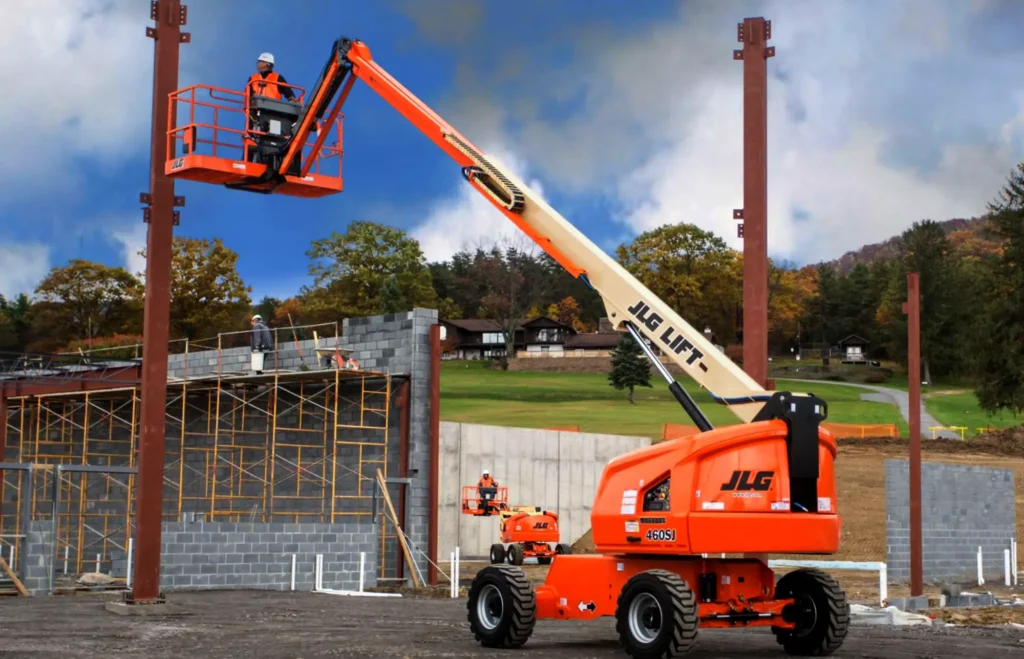
For heavy earthmoving, such as an excavator or a grader working on a road base for 12 months, a long-term contract is almost always the right call. For a boom lift rental in Dubai covering a two-week cladding installation window, short-term hire wins on simplicity and administrative speed.
| Factor | Short-term hire | Long-term rental |
| Daily rate | Higher (20-35% premium) | Lower, locked in by contract |
| Commitment | None, cancel anytime | Agreed minimum period |
| Maintenance cost | Usually included | Usually included / shared |
| Utilisation flexibility | High, swap machines as needed | Lower, tied to agreed fleet |
| Mobilisation cost | Per trip (higher total) | One-time or periodic |
| Cash flow | Variable, no forward commitment | Predictable, fixed monthly cost |
| Tax treatment (UAE) | Expense (opex) | Expense (opex) |
| Best for | Spot needs, short programmes | Long-running, high-utilisation sites |
Construction contracts in the UAE take several forms, and the contract type is one of the strongest predictors of which rental model a contractor should use.
Under a lump-sum or fixed-price contract, the contractor absorbs all cost risk. Predictable equipment spend (which long-term rental provides) supports the margin discipline that fixed-price work demands. A spike in short-term hire rates during peak demand periods (Q1 and Q4 are historically the busiest in Dubai) can erode the margin on a fixed-price job significantly.
Under reimbursable or cost-plus contracts, typically used for complex industrial and infrastructure work in JAFZA, KIZAD, and Musaffah, short-term hire gives the client’s cost controller visibility on discrete charges without the complexity of amortising a long-term fleet agreement. Both arrangements are in active use across the UAE market, and CDHorizon structures equipment rental for construction projects in the UAE to fit either framework.
Different construction verticals in the UAE produce distinctly different rental profiles.
| Sector | Typical equipment | Preferred model | Key consideration |
| High-rise residential (Dubai, Abu Dhabi) | Scissor lifts, boom lifts, scaffolding | Long-term (12-36 months) | Continuous access throughout build cycle |
| Infrastructure and road works | Excavators, graders, backhoe loaders | Long-term (6-24 months) | Heavy utilisation, daily shifts |
| Industrial and JAFZA fit-out | Telehandlers, aerial platforms, generators | Mixed: long for core, short for peaks | Variable workflow density |
| Façade and external maintenance | Spider lifts, NEO scaffolding, boom lifts | Short-term (1-8 weeks) | Fixed-scope, defined access window |
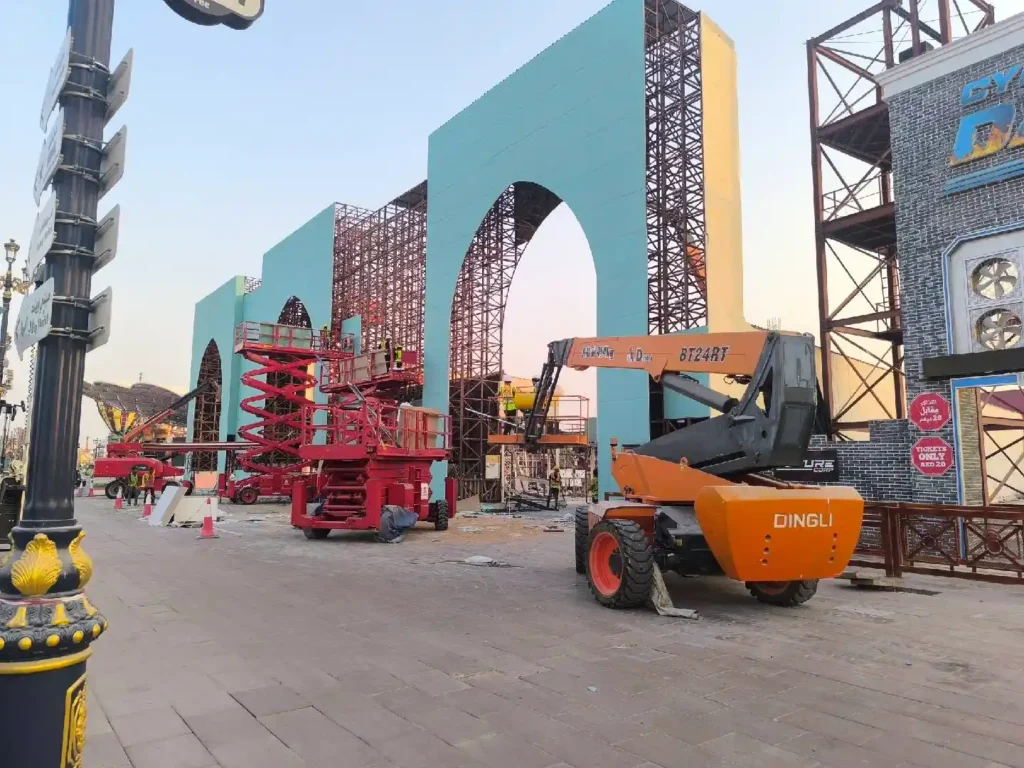
| Events and temporary structures | Scissor lifts, generators, modular scaffolding | Short-term (1-14 days) | Speed of mobilisation is priority |
| Port and logistics construction (Abu Dhabi ports) | Wheel loaders, telehandlers, excavators | Long-term (12-30 months) | Controlled site access, continuous programme |
For contractors working on residential towers in Business Bay or on infrastructure along the Mohammed Bin Rashid Logistics Corridor, a long-term fleet agreement covering scissor lift hire in the UAE and scaffolding rental in the UAE eliminates the daily rate volatility that erodes tight programmes.
NEO scaffolding systems and shoring frames are structurally engineered products, not commodity tubes and fittings. Their setup requires certified technical personnel, structural drawings, and in many cases a third-party inspection sign-off before any access is permitted.
Mobilising a NEO scaffolding system for a two-week job frequently costs as much in setup and strike as the rental rate itself. The economics flip decisively when the access requirement runs longer than six weeks: the amortised cost per week drops sharply, and the productivity gain from a stable, purpose-engineered system versus improvised access is measurable in labour-hours saved.
CDHorizon deploys NEO shoring and NEO scaffolding systems across the UAE with full technical support, structural engineering input, and on-site supervision at key stages. The services page details the complete formwork and technical service offering for contractors who need more than a machine drop-off.
| CDHorizon note: NEO scaffolding and shoring rental agreements are structured as medium-to-long-term contracts as standard. Short-term deployments are assessed case by case based on site complexity and mobilisation cost. |
United Rentals, the world’s largest equipment rental company, and Sunbelt Rentals (part of Ashtead Group) have both publicly reported a structural shift in their revenue mix toward longer contract durations. In their most recent annual results, both groups noted that fleet on contract terms of six months or longer was generating higher revenue per unit and lower utilisation volatility than spot hire.
Loxam Group, which operates across the Middle East and Africa in addition to its core European market, has introduced tiered contract pricing that rewards contractors who commit to a defined fleet for a defined period with rate stability guarantees. The direction of travel globally is clear: rental companies are building their businesses around predictable long-term commitments, and contractors who understand that dynamic get better commercial terms.
CDHorizon is a subsidiary of Far East Horizon (HKEX: 09930.HK), a group with over 560 rental locations, 400,000 clients served, and a ranking of 11th in the IRN100 (2025). That global infrastructure, deployed locally in the UAE since 2023, gives contractors access to a modern, safety-certified fleet backed by the procurement, maintenance, and logistics systems of a top-tier international operator.
The fleet covers four categories directly relevant to the long-term versus short-term decision: aerial work platforms (boom lifts, telescopic boom lifts, diesel scissor lifts), earthmoving equipment, generators, and NEO scaffolding systems. All machines are maintained in-house to manufacturer standards and are safety-certified before every deployment.
Contractors working with CDHorizon on long-term rental agreements receive dedicated account support, proactive maintenance scheduling that keeps machines on site rather than in the workshop, and flexible fleet adjustment provisions if site scope changes mid-programme. That operational depth is what separates CDHorizon from commodity hire yards across the emirate.
No single rule fits every project. The framework below helps project managers and procurement leads run through the key variables systematically.
| Question | Long-term rental is indicated if… | Short-term hire is indicated if… |
| Project duration | Programme exceeds 3 months | Programme is under 6 weeks |
| Equipment utilisation | Machine is on site more than 60% of working days | Machine is needed for a defined, bounded task |
| Contract type | Fixed-price or lump-sum (cost certainty needed) | Cost-plus or reimbursable (per-item billing) |
| Fleet size needed | Multiple machines of the same type | One or two units for a specific phase |
| Maintenance capacity | Prefer to outsource upkeep | Comfortable with self-management of hire logistics |
| Budget cycle | Capex approval for long-term commitment feasible | Project funded in short tranches |
| Specialised systems (NEO scaffolding / shoring) | Setup cost is high, justify over longer duration | Only if a very short window AND pre-built system available |
Contractors unsure which model fits a specific programme can use CDHorizon’s project cases as a reference point: the portfolio spans school infrastructure in Abu Dhabi, warehouse construction at Abu Dhabi Port, façade maintenance, and large public-event access solutions.
Power supply on UAE construction sites is often a hybrid problem. The main electrical infrastructure may not be live for months into a programme, yet the site needs power from day one for tools, lighting, concrete curing, and site offices.
Short-term generator hire makes sense when grid power is confirmed within two to three months and the load profile is well defined. Where grid connection is delayed (which happens regularly on greenfield developments outside established urban boundaries), on greenfield developments outside established urban boundaries a long-term rental on an Airman diesel unit or a Denyo electric generator provides budget certainty across a period that can stretch to 18 months or more.
CDHorizon’s products page covers both Airman 60 KVA diesel generators and Denyo 220 KVA electric generators, both available on short-term and long-term rental arrangements depending on site requirements.
McKinsey’s research on construction productivity consistently shows that construction equipment on active sites is underutilised significantly more than managers estimate. When a machine is idle for more than 40% of available working time, the daily cost per productive unit of work climbs sharply.
The utilisation question reframes the long-term versus short-term debate. If a contractor commits to a six-month aerial work platform rental in the UAE but the machine runs at 40% utilisation, the effective cost per productive day is nearly double the headline rate. In that scenario, short-term hire (pulling the machine in only for active phases) is the financially rational choice even though the daily rate is higher.
CDHorizon account managers routinely work through utilisation projections with clients before recommending a contract duration. The output of that conversation is a rental structure that fits real site rhythms rather than optimistic programme assumptions.
| Utilisation rate | Recommended model | Rationale |
| Below 40% | Short-term hire | Long-term commitment creates idle-cost drag |
| 40% to 60% | Mixed: review per equipment category | Analyse break-even point per machine type |
| 60% to 80% | Long-term rental | Consistent use justifies rate lock-in |
| Above 80% | Long-term rental (priority) | High-utilisation machines justify multi-year agreements |
Several structural shifts are reshaping how UAE contractors approach equipment decisions.
Electrification of the fleet. Regulatory pressure across the GCC, aligned with UAE Net Zero 2050 commitments, is pushing procurement teams to specify electric aerial work platforms and hybrid earthmoving equipment. Electric scissor lifts and electric telescopic boom lifts, both available in CDHorizon’s fleet, carry a higher acquisition cost, which makes rental (rather than purchase) the preferred access model for most contractors.
Longer project pipelines. With the UAE’s infrastructure pipeline extending through 2030 and beyond (EXPO legacy works, new airport expansions, road network upgrades across Sharjah and Ras Al Khaimah), the average programme duration for infrastructure contracts is extending. Longer projects naturally favour long-term rental structures.
Sustainability reporting in supply chains. International contractors operating in the UAE under ESG frameworks need to account for equipment emissions and safety standards in their project reporting. Renting from a certified operator with documented maintenance records is becoming a procurement requirement, not just a preference.
Long-term equipment rental in the UAE typically covers periods from three months to several years, with a fixed rate agreed at the start of the contract. Short-term hire covers day-to-day or week-to-week needs with no minimum commitment but at a higher daily cost. The right choice depends on how long you need the machine and how intensively you will use it.
For most contractors, long-term rental is cheaper than purchasing on a total cost of ownership basis, particularly when maintenance, insurance, storage, and resale risk are included. Equipment purchase also ties up capital that could be deployed elsewhere on the project. Heavy equipment leasing in Dubai and the UAE has grown significantly as contractors move away from capex-heavy fleet ownership.
CDHorizon’s product range covers aerial work platforms (electric and diesel scissor lifts, articulated and telescopic boom lifts, spider lifts), earthmoving equipment (excavators, graders, backhoe loaders, bulldozers, wheel loaders, telehandlers), generators (Airman diesel, Denyo electric), and NEO scaffolding systems. All are available on both long-term and short-term rental arrangements.
You can request a quote directly via the CDHorizon contact page. Provide the equipment type, site location, programme start date, and expected duration. CDHorizon’s team will assess the utilisation profile and recommend the most cost-effective rental structure.
Short-term scissor lift hire in the UAE is typically available from one day. CDHorizon offers daily, weekly, and monthly rates for electric and diesel scissor lifts, with long-term contracts kicking in at three months and providing a reduced daily rate. The electric scissor lift page has full specification details.
Yes. Short-term boom lift rental in Dubai is available for single-day or single-week access requirements. CDHorizon offers both articulated and telescopic diesel boom lifts on short-term hire. For programmes longer than six weeks, a longer-term contract is usually more cost-effective.
Standard long-term rental agreements in the UAE from CDHorizon include the machine, preventive maintenance, safety certification, and delivery to site. Some agreements also include operator training and on-call technical support. The exact inclusions depend on the equipment category and contract duration.
NEO scaffolding systems require structural design input, certified installation personnel, and in many projects a third-party inspection. Because the setup and strike costs are significant, CDHorizon structures most NEO scaffolding rental in the UAE as medium-to-long-term contracts. Short-term deployment is available for specific cases, assessed on a project-by-project basis.
High-rise projects in Dubai typically run for 18 to 36 months and require aerial work platforms, NEO scaffolding, and earthmoving equipment across multiple phases. A long-term rental agreement covering core fleet, with the option to add short-term machines for peak phases, is usually the most cost-effective and operationally smooth approach. CDHorizon structures bespoke contracts for high-rise programmes across Business Bay, Downtown Dubai, and Jumeirah.
Telehandler rental in Dubai is available from CDHorizon on both short-term and long-term contracts. Telehandlers on logistics and construction sites with continuous material-handling requirements are well suited to long-term agreements, which reduce the per-lift cost across extended programmes.
Rental eliminates capital expenditure, avoids depreciation accounting, and transfers maintenance risk to the rental provider. For contractors working on projects of 12 months or less, rental is almost universally more cost-effective than purchase. For longer programmes, a total cost of ownership analysis comparing heavy equipment leasing in Dubai against purchase should be run with the rental provider.
Aerial work platform rental covers any machine that lifts personnel to height: scissor lifts, articulated boom lifts, telescopic boom lifts, and crawler spider lifts. CDHorizon’s aerial work platform rental in the UAE includes electric and diesel variants across all four categories, suited to everything from indoor maintenance tasks to high-rise façade access.
Yes. CDHorizon offers Airman 60 KVA diesel generators and Denyo 220 KVA electric generators for long-term rental across the UAE. Long-term generator contracts are particularly valuable on greenfield development sites where grid power may not be available for 12 months or more.
Earthmoving equipment rental in Abu Dhabi from CDHorizon includes excavators, graders, backhoe loaders, bulldozers, and wheel loaders. These are primarily suited to long-term rental given their intensive daily use on infrastructure and civil engineering sites.
The key variables are project duration, equipment utilisation rate, and contract type. If a machine will be on site and active for more than 60% of working days and the programme exceeds three months, long-term rental will almost always be cheaper in total cost terms. CDHorizon can assist with a project-specific cost comparison before you commit to a contract structure.
Yes. A mixed approach is common on complex projects with distinct phases. Core equipment running across the full programme, such as a diesel scissor lift used daily through the structural phase, is placed on a long-term agreement, while phase-specific machines are brought in on short-term hire. CDHorizon manages mixed fleet arrangements as a single account.
A global operator brings standardised maintenance protocols, larger fleet depth (so replacement machines are available when a unit goes for service), and documented safety certification, all of which matter to international contractors with ESG reporting requirements. to international contractors with ESG reporting requirements. CDHorizon, backed by Far East Horizon, offers that global standard with local operational presence in the UAE.
Modular scaffolding rental in Dubai is available for short-term access requirements such as façade cleaning, window replacement, or mechanical-electrical inspections. For structural or complex access systems, the setup cost relative to the hire period usually makes a short-duration contract expensive, and CDHorizon will advise accordingly before agreeing a contract.
Most CDHorizon long-term rental agreements include provisions for programme extensions at the contracted rate, subject to fleet availability. For contractors working on government or semi-government infrastructure projects, where programme delays can occur due to authority approvals: this rate-stability clause is a valuable budget protection.
Every machine leaving CDHorizon’s service centres is inspected, certified, and accompanied by up-to-date service documentation. CDHorizon also provides operator training and safety briefings, and the team conducts on-site visits for complex deployments. Contractors can present CDHorizon’s certification documents to UAE authority inspectors on request.