On a UAE site, the ground is the only place nobody argues with. Every metre above it is governed by working at height regulations in the UAE, from Dubai Municipality working at height rules to Abu Dhabi ADOSH-SF working at height codes, and in 2027 those UAE working at height regulations decide who climbs, on which boom lift, scissor lift or scaffolding, and with whose paperwork. Work at height safety in the UAE, MEWP regulations in Dubai and scaffolding regulations in Abu Dhabi now sit at the centre of every contractor’s compliance plan.
For contractors in Dubai, Abu Dhabi and across the UAE, 2025 and 2026 rewrote the rulebook for 2027. Dubai issued Decree No. 19 of 2025 on safety in construction works, Abu Dhabi now enforces working at height under the ADOSH-SF framework, and Dubai Municipality followed up with a new construction safety guide in 2026. CDHORIZON, one of the best and top-ranked aerial work platform rental companies in the UAE, supplies the boom lifts, scissor lifts, spider lifts and Neo scaffolding that let contractors meet these working at height rules on Dubai and Abu Dhabi sites.
This guide sets out the working at height regulations UAE contractors must know: who regulates work at height in Dubai and Abu Dhabi, the key numbers in each code, what applies to MEWPs and scaffolding, and how to pick compliant access equipment rental in the UAE. It explains what the law asks for. The detailed technical method belongs with your HSE team, a certified inspector and an experienced working at height equipment partner.
Falls are the single biggest killer on UAE construction sites. The Department of Health Abu Dhabi recorded that falls and falling objects caused 53 of the 71 workplace deaths in the emirate in 2011, making them the leading cause of fatal worksite injuries. That record drove a decade of tighter work at height safety rules across the UAE.
The pace has picked up. Dubai’s Decree No. 19 of 2025 places every contractor and engineering consultant under a single construction safety code, including free zones such as DIFC. Abu Dhabi’s ADOSH-SF Code of Practice 23.0 on working at height was reissued as version 4.0 in July 2024. On top sits the federal labour framework, which makes the employer responsible for a safe workplace.
For contractors, the practical result is simple. Working at height in Dubai or Abu Dhabi now needs certified equipment, trained operators, written rescue plans and inspection records that an auditor can check on the day. A boom lift rental in Dubai or a scissor lift rental in Abu Dhabi without the right paperwork is a compliance gap, not a saving.
There is no single UAE working at height law. Work at height safety in the UAE sits across federal, emirate and free zone layers, and contractors working in both Dubai and Abu Dhabi must meet both sets of working at height rules.
At federal level, the UAE Government portal lists Federal Decree-Law No. 33 of 2021 on labour relations, Cabinet Resolution No. 1 of 2022 and Ministerial Resolution No. 44 of 2022 on occupational health and safety. These set the employer’s duty of care, the health and safety officer requirement, and the 48-hour deadline for reporting work injuries to MoHRE.
Table 1. Who regulates working at height in the UAE
| Level | Instrument | Regulator | Scope for contractors |
|---|---|---|---|
| UAE federal | Decree-Law 33 of 2021, Ministerial Resolution 44 of 2022 | MoHRE | Duty of care, safety officer, injury reporting |
| Dubai | Decree No. 19 of 2025 on safety in construction works | Dubai Municipality | One safety code for all Dubai construction |
| Dubai | Administrative Resolution No. 112 of 2026 | Dubai Municipality | Approves the Safety Guide for Construction Works |
| Dubai | Technical Guideline DM-HSD-GU67 for MEWPs | Dubai Municipality | Boom lifts, scissor lifts, spider lifts |
| Abu Dhabi | ADOSH-SF CoP 23.0 Working at Height, v4.0 | ADPHC | Fall prevention, guardrails, rescue, training |
| Free zones | Covered by Decree 19 of 2025 in Dubai | DM and zone authority | DIFC and Dubai free zone sites |
Decree No. 19 of 2025, issued on 7 April 2025, is the biggest change to working at height regulations in Dubai in nearly two decades. It repeals Administrative Resolution No. 51 of 2008 and requires all contractors and engineering consultancy firms to comply with one Safety Code across the emirate, including special development zones and free zones.
The decree gives Dubai Municipality inspectors law enforcement powers to enter sites, issue violation reports and call police support. Penalties are set by a separate Executive Council resolution. In June 2026, Administrative Resolution No. 112 of 2026 approved the Safety Guide for Construction Works that carries the detailed rules.
Dubai Municipality’s construction safety guide keeps the core scaffolding rule contractors know: scaffolds must be inspected every six months by an approved inspection company, re-certified after any alteration, height increase or move, and erected only by competent personnel. Hoists need six-monthly inspection and lifting equipment a full annual inspection.
The decree also closes a gap for free zone sites. Contractors working in DIFC, JAFZA or other Dubai free zones now answer to the same construction safety code as mainland sites, so one set of working at height documents, inspection certificates and training records must travel with every MEWP and scaffold, wherever the site sits in Dubai.
For Dubai contractors, the safest route is to work only with certified, documented aerial work platforms and scaffolding materials from a top equipment rental company in Dubai that understands the 2025 decree.
Mobile elevated work platforms are governed in Dubai by Dubai Municipality Technical Guideline DM-HSD-GU67. It applies to every establishment using a MEWP in Dubai, from a diesel telescopic boom lift on a tower façade to an electric scissor lift inside a mall.
The headline MEWP regulations in Dubai are clear:
This is why the choice of boom lift rental in Dubai, articulated boom lift rental and spider lift rental in the UAE is a compliance decision. CDHORIZON runs one of the best MEWP fleets in Dubai and Abu Dhabi, from 8 m electric scissor lifts to 58 m diesel telescopic booms, with pre-mobilisation checks and preventive maintenance under its heavy equipment rental safety programme.
In Abu Dhabi, working at height is governed by the Abu Dhabi Occupational Safety and Health System Framework. The ADOSH-SF Code of Practice 23.0, Working at Height, version 4.0 dated 15 July 2024, replaced the earlier OSHAD-SF name and applies to contractors across Abu Dhabi city, Musaffah, ICAD, KIZAD, Al Ain and Al Dhafra.
ADOSH-SF defines working at height as any work where a fall could cause injury, from any height, including below ground level. It sets a strict hierarchy: avoid work at height where you can, prevent falls where you cannot avoid it, and only then reduce the distance and consequences of a fall.
Under the Abu Dhabi working at height regulations, guardrails must stand at least 950 mm high with toe boards of at least 150 mm and gaps no greater than 470 mm. Fall arrest anchorages must be independent and certified, rescue plans are required wherever fall arrest is used, and training must happen before any worker is assigned to a fall-hazard job.
For Abu Dhabi contractors, the hierarchy favours collective protection. A guarded platform on a scissor lift rental in Abu Dhabi or an electric articulated boom lift prevents falls by design, which ranks above harness-based fall arrest under ADOSH-SF.
Table 2. Dubai vs Abu Dhabi working at height compliance
| Topic | Dubai | Abu Dhabi |
|---|---|---|
| Main instrument | Decree 19 of 2025 and 2026 Safety Guide | ADOSH-SF CoP 23.0, v4.0 (2024) |
| Regulator | Dubai Municipality | ADPHC |
| MEWP inspection | Every 6 months, EIAC-accredited third party | Per ADOSH-SF lifting and WAH codes |
| Scaffold inspection | Every 6 months by approved company | Every 7 days plus documented 6-monthly |
| Operator training | ISO 18878 based, every 2 years | Before assignment, with refreshers |
| Rescue plan | Required for trapping risk | Required wherever fall arrest is used |
Auditors in Dubai and Abu Dhabi check numbers, not intentions. These are the key working at height figures drawn from the UAE codes above.
Table 3. Key working at height regulation figures in the UAE
| Requirement | Figure | Source |
|---|---|---|
| Fall potential triggering guardrails or fall protection | 2 m | ADOSH-SF CoP 23.0 |
| Minimum guardrail height | 950 mm | ADOSH-SF CoP 23.0 |
| Minimum toe board height | 150 mm | ADOSH-SF CoP 23.0 |
| Maximum gap between guardrails | 470 mm | ADOSH-SF CoP 23.0 |
| Working platform inspection interval | 7 days | ADOSH-SF CoP 23.0 |
| MEWP third-party inspection | Every 6 months | DM-HSD-GU67 |
| Scaffold inspection by approved company | Every 6 months | Dubai Municipality |
| MEWP operator retraining | Every 2 years | DM-HSD-GU67 |
| Clearance from power lines on steel towers | 15 m | DM-HSD-GU67 |
| Training record retention | 5 years | DM-HSD-GU67 |
| Work injury report to MoHRE | 48 hours | u.ae |
Scaffolding regulations in the UAE focus on three things: competent erection, regular inspection and visible status. In Dubai, scaffolds need six-monthly inspection by an approved company and re-certification after changes. In Abu Dhabi, ADOSH-SF requires working platforms and fall protection to be inspected at intervals of no more than 7 days, with a documented inspection at least every 6 months, and damaged items tagged and stored apart.
Component quality is where many scaffolding compliance failures start. CDHORIZON supplies the Neo scaffolding system with forged alignment couplers, high-strength standard clamps and scaffold brackets built for UAE heat and coastal humidity. It is one of the top scaffolding rental options in Dubai and Abu Dhabi for contractors who want consistent, traceable components.
For slab and beam pours, shoring falls under the same working at height and temporary works scrutiny. CDHORIZON pairs Neo shoring with formwork technical services covering design, structural analysis and on-site load checks, so the temporary works package arrives with engineering behind it.
Both Dubai and Abu Dhabi working at height regulations treat fall protection as the last line of defence, not the first. Collective measures such as guardrails, platforms and aerial work platforms come first. Harnesses and lanyards come in where collective protection is not practicable.
Where fall arrest is used, a written rescue plan is mandatory. Suspension trauma can set in within minutes, so the plan has to name the rescue method, the people and the equipment before the work starts. Dubai Municipality also expects periodic emergency lowering drills for MEWPs.
Training is where most UAE contractors fall short at audit. Dubai requires ISO 18878 based MEWP operator training every two years. Abu Dhabi requires training before assignment, refreshers after any change, and records that include each worker’s Emirates ID. CDHORIZON runs safety and operator training in the UAE covering equipment operation and maintenance, with certification for operators and service engineers. The technical detail of harness checks, anchor selection and rescue technique belongs in that certified training, not in a site handout.
UAE summers add a second layer of working at height risk. According to Gulf News, MoHRE bans outdoor work in direct sunlight from 12:30 pm to 3 pm between 15 June and 15 September, with fines of up to AED 50,000 per violation.
Heat stress, dehydration and fatigue all raise fall risk at height. Contractors compress outdoor work at height into mornings and evenings, which concentrates MEWP hours and puts more weight on reliable machines and fast breakdown support. Electric units such as the electric telescopic boom lift and electric articulated boom lift let teams move work indoors during peak heat, while site lighting and power from the Denyo 220 kVA generator or Airman 60 kVA generator support safe evening shifts.
The best way to meet working at height regulations in the UAE is to choose equipment that removes the fall hazard by design. The table maps common tasks in Dubai and Abu Dhabi to compliant access equipment from CDHORIZON.
Table 4. Compliant working at height equipment by task
| Task | Compliant access option | CDHORIZON rental |
|---|---|---|
| Indoor ceilings, MEP, mall fit-out | Electric scissor lift with guarded deck | Electric scissor lift rental |
| Outdoor roofs, cladding, steel decking | Rough-terrain scissor lift | Diesel scissor lift rental |
| High-rise façades, steel erection | Telescopic boom with restraint harness | Diesel telescopic boom lift |
| Indoor high bays, hangars | Electric telescopic boom | Electric telescopic boom lift |
| Work over pipe racks, canopies | Articulated boom | Diesel articulated boom lift |
| Atriums, tight or soft floors | Tracked spider lift | Spider lift rental |
| Many trades on one elevation for weeks | Inspected system scaffold | Neo scaffolding rental |
| Placing loads at height | Telehandler, not a person on a ladder | Telehandler rental |
Working at height regulations apply the same way across the UAE, but the risk profile changes with the project. Planning the access equipment around the project type is the quickest way to stay compliant with Dubai Municipality and ADOSH-SF rules.
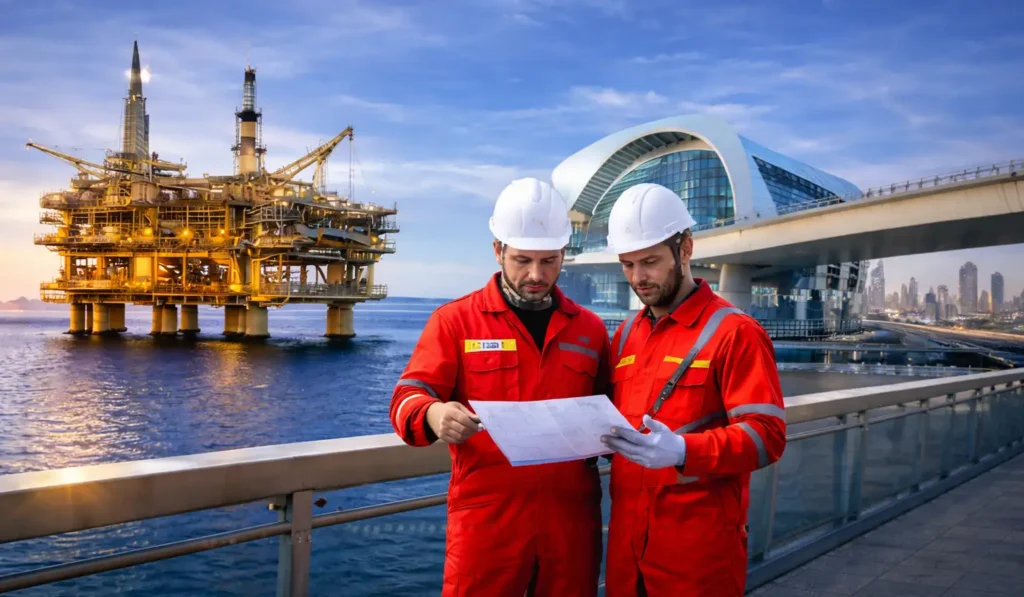
High-rise towers in Dubai Marina, Business Bay and Al Reem Island. Façade installation, glazing and steel work at extreme height call for diesel telescopic boom lifts up to 58 m, certified restraint harnesses and a rescue plan for every machine. Wind checks before each lift are part of Dubai Municipality MEWP guidance, since wind can be 50% stronger at 20 m than at ground level.
Warehouses and industrial sites in JAFZA, Dubai South, KIZAD and ICAD. Roof sheeting, racking and MEP work suit diesel scissor lifts outdoors and electric scissor lifts indoors, with articulated booms to reach over pipe racks and mezzanines. A telehandler keeps loads off ladders and off workers’ shoulders.
Malls, hotels, hospitals and airports in Dubai and Abu Dhabi. Occupied buildings need quiet, zero-emission access. Electric articulated boom lifts, electric telescopic booms and bi-energy spider lifts protect finished floors while keeping workers inside guarded platforms.
Infrastructure, utilities and energy projects across the UAE. Bridges, substations and plant shutdowns combine MEWPs with Neo scaffolding and engineered shoring. Power line clearances of 15 m and 9 m under Dubai Municipality rules shape where each boom can be positioned, and DEWA or ADDC requirements can be stricter.
Events and exhibitions in Dubai and Abu Dhabi. Rigging and stand building at venues across both emirates rely on spider lifts and scissor lifts, supported by the Airman 60 kVA and Denyo 220 kVA generators for charging and site power.
Global rental groups such as United Rentals, Sunbelt Rentals and Loxam treat working at height compliance as a service, not a sticker. They track inspection status through telematics, require certified operator cards at hand-over, and supply rescue kits and familiarisation with every MEWP.
The benchmark for UAE contractors is the same. Judge a working at height rental partner on inspection records, operator training, rescue support and fleet age, as much as on the daily rate.
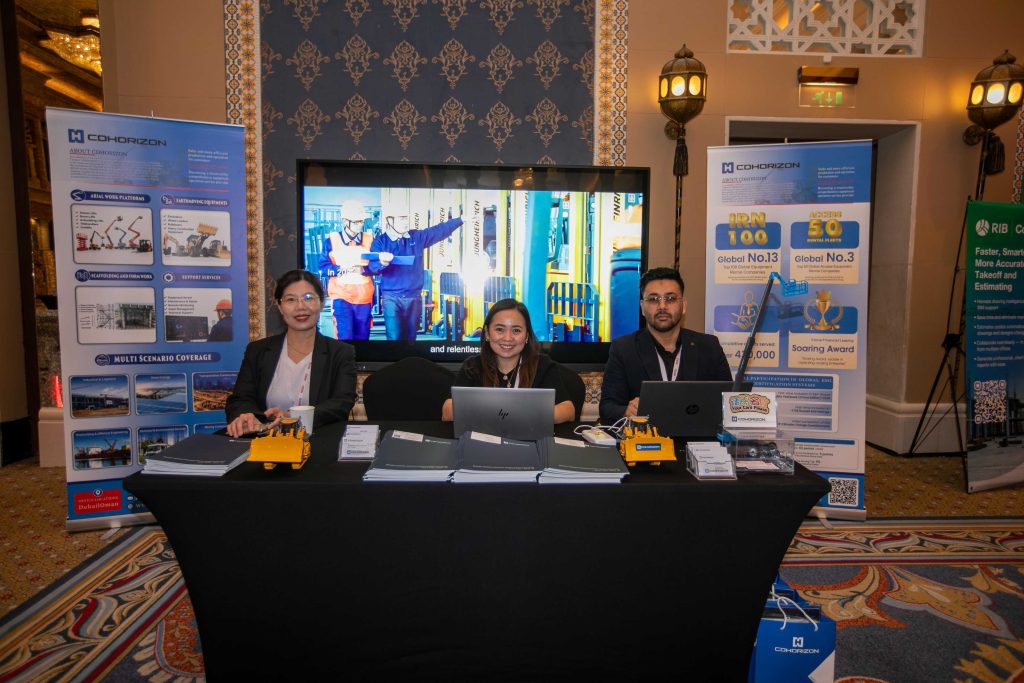
CDHORIZON is the UAE arm of Hong Kong listed Horizon Construction Development, one of the largest equipment rental groups in the world. That scale is why many contractors rate CDHORIZON as the No.1 aerial work platform rental company in the UAE and a top working at height equipment partner in both Dubai and Abu Dhabi.
See the fleet working on live UAE sites on the CDHORIZON projects page, or read more about CDHORIZON.
Use this checklist when comparing working at height equipment rental companies in Dubai, Abu Dhabi and across the UAE.
Table 5. Checklist for a compliant working at height rental partner
| Ask for | Why the regulator expects it | Where to start |
|---|---|---|
| Current third-party inspection certificate | DM requires 6-monthly EIAC-accredited checks | AWP range |
| Operator training records | ISO 18878 based, refreshed every 2 years | Training services |
| Rescue and emergency lowering support | Mandatory rescue plans in Dubai and Abu Dhabi | Heavy equipment safety |
| Scaffold component traceability | Inspection and tagging under both codes | Neo scaffolding |
| Temporary works engineering | Shoring and formwork need design sign-off | Formwork services |
| Fast replacement of faulty units | Defective MEWPs must be isolated and tagged | Equipment rental |
Working at height regulations in the UAE combine federal labour law (Decree-Law 33 of 2021 and Ministerial Resolution 44 of 2022) with emirate codes. Dubai follows Decree No. 19 of 2025 and Dubai Municipality guidelines, and Abu Dhabi follows ADOSH-SF CoP 23.0. CDHORIZON supplies compliant access equipment across the UAE.
Decree No. 19 of 2025 is Dubai’s law on safety in construction works. It requires all contractors and consultants, including those in free zones, to follow one Dubai Municipality Safety Code and gives inspectors enforcement powers.
ADOSH-SF treats any height where a fall could cause injury as working at height. A 2 m fall potential is the main trigger for guardrails and fall protection under CoP 23.0.
The framework is now called ADOSH-SF, the Abu Dhabi Occupational Safety and Health System Framework. CoP 23.0 version 4.0, issued in July 2024, carries the working at height rules for Abu Dhabi contractors.
Dubai Municipality requires every MEWP to be inspected every six months by an EIAC-accredited third party, plus checks before and after each use. Ask your boom lift rental company in Dubai for the current certificate.
Dubai Municipality requires MEWP operator training from an EIAC-accredited third party based on ISO 18878, such as IPAF, refreshed at least every two years. A supplier’s demonstration alone does not meet the rule.
Under Dubai Municipality guidance, vertical scissor lifts do not normally require a harness unless the risk assessment calls for one. Boom lifts require a full body harness with a short restraint lanyard. CDHORIZON offers scissor lift rental in Dubai and Abu Dhabi.
Dubai requires six-monthly scaffold inspection by an approved company and re-certification after changes. Abu Dhabi requires working platform inspections at intervals of no more than 7 days, with a documented inspection at least every 6 months.
ADOSH-SF CoP 23.0 requires guardrails at least 950 mm high, toe boards at least 150 mm high and gaps no greater than 470 mm. Guarded aerial work platforms build this protection into the machine.
Yes. Abu Dhabi requires a rescue plan wherever fall arrest is used, and Dubai requires one wherever MEWP trapping risks exist. Plans must be ready before work starts.
CDHORIZON is one of the best and top-ranked boom lift rental companies in the UAE, with telescopic booms up to 58 m and articulated booms up to 43 m, backed by safety checks and training.
CDHORIZON is among the top scaffolding rental suppliers in Dubai and Abu Dhabi, with Neo scaffolding components and Neo shoring backed by formwork engineering.
Dubai Municipality sets a minimum of 15 m from lines on steel towers and 9 m from lines on poles, or the stricter DEWA requirement. All lines are treated as live unless declared dead by the operator.
Yes. Outdoor work in direct sunlight is banned from 12:30 pm to 3 pm between 15 June and 15 September across the UAE, with fines of up to AED 50,000. Electric boom lifts for indoor work help keep programmes moving.
The employer carries the legal duty of care under UAE law, including risk assessment, training and rescue planning. The rental company supplies inspected, certified equipment, so choose a partner like CDHORIZON that keeps records ready.
Work injuries must be reported to MoHRE within 48 hours. Dubai Municipality guidance also expects written accident reports within 72 hours and records kept for five years.
Equipment with built-in guardrails, such as scissor lifts, boom lifts and spider lifts, ranks higher in the control hierarchy than ladders or harness-only work. CDHORIZON offers spider lift rental in the UAE for tight and delicate spaces.
Yes. CDHORIZON runs safety and operator training covering equipment operation and maintenance, with certification for operators and service engineers in Dubai and Abu Dhabi.
Yes. CDHORIZON supplies equipment rental across the UAE, including Abu Dhabi city, Musaffah, KIZAD, ICAD, Al Ain, Dubai, Sharjah and the northern emirates.
CDHORIZON combines a wide modern MEWP fleet, Neo scaffolding, training and formwork engineering under one contract, backed by a Hong Kong listed rental group. Contact CDHORIZON for a quote in Dubai or Abu Dhabi.